

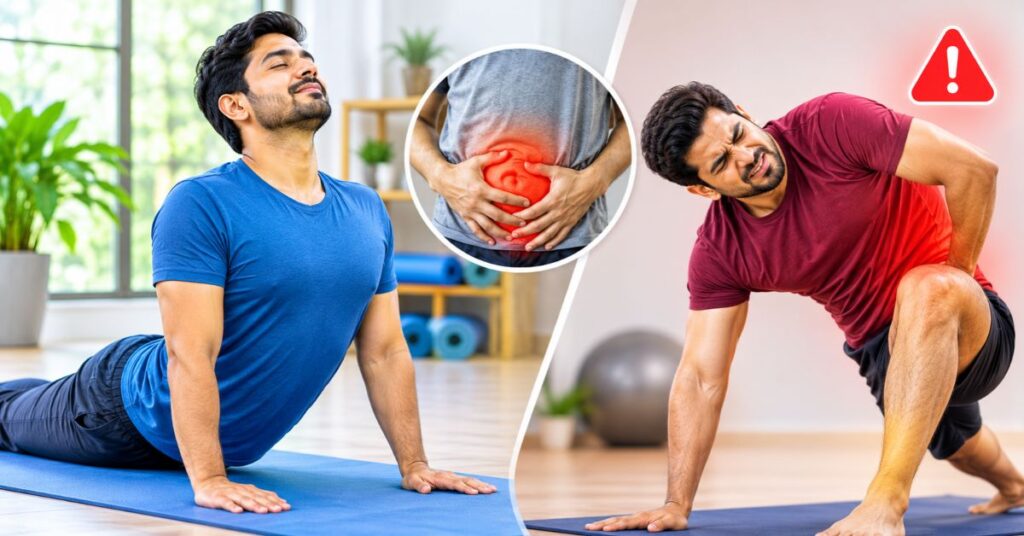
Yoga is popular with people of all ages, valued for flexibility, calmness, and strength. But some poses apply heavy pressure on the abdomen, and that is something to consider if you have or are prone to a hernia. Knowing which poses are good and which to avoid makes your practice safer.
Gentle Poses That Are Usually Safe
- Cat-Cow: Mobilizes the spine with minimal abdominal demand.
- Child’s pose: Helps relax the back and encourages slow breathing.
- Easy Bridge Pose Strengthens glute and lower back muscles.
- Legs-up-the-wall: Pressure-relieving, relaxing position.
- Supported side stretches: Open the ribs and sides without squashing them.
Threats of Abdominal Strain or Injury
- Full plank and hold boat pose: Requires strong abdominal contraction.
- Deep backbends and wheels: Stretching the abdominal wall under tension. Inversions and Shoulder stands: Vary the pressure unpredictably.
- Strong bandhas and deep twists: Squeeze the belly.
- Quick breathing methods such as Kapala Bhati: Make repeated spikes of pressure in the abdominal region.
Breathing Is Most Important
Breathe slowly and regularly, so that the pressure remains constant. Never hold your breath during a stretch and never force yourself into a pose until you can feel the pull on the abdominal wall.
Practical Tips
Use props like blocks and bolsters, pick a qualified instructor, and tell them about your condition. If you feel a bulge or sharp discomfort, stop right away.
Verify Before You Proceed
Some hernias will not yield to stretching. A hernia specialist in Indore can assess your type, location, size, and then advise you what is safe.
If symptoms appear during practice, don’t take a chance, visit a hernia doctor in Indore. Repeated strain on the unchecked hernia can make it bigger.
With just a few mindful changes, you can keep yoga a lifelong practice. Opt for slow and supported movements, breathe evenly, and let comfort guide your practice.