

Only for Informational Purposes. See a qualified hernia surgeon for an assessment of your individual risk.
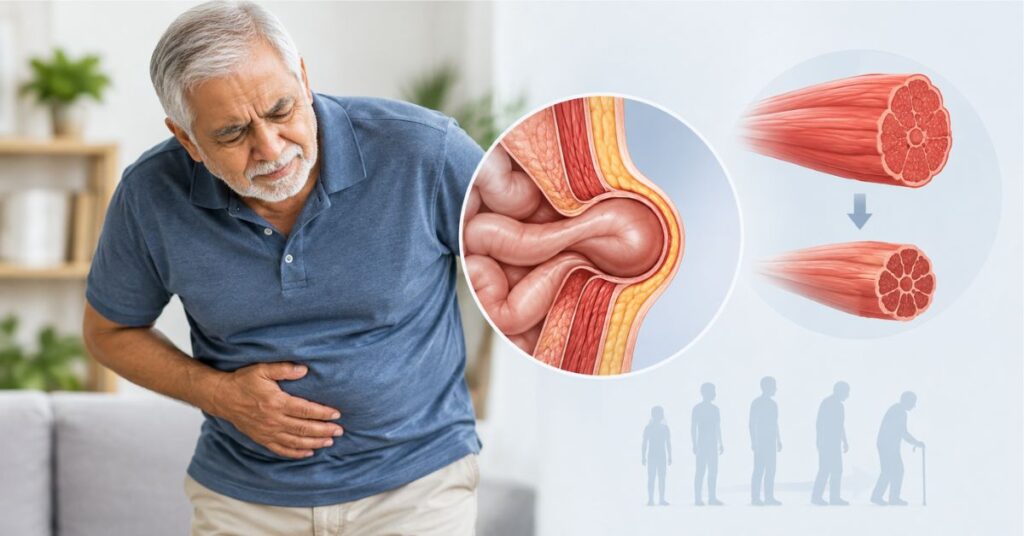
Hernias can happen at any age, but the risk increases as you get older. It’s not an accident; it’s the natural evolution of muscle and connective tissue in the body over time and how those changes affect the ability of the abdominal wall to hold everything in place.
What Actually Gets Weaker with Age and Increases Hernia Risk?
The abdominal wall is able to withstand everyday pressure thanks to a combination of muscle and connective tissue, in particular collagen. Both decline with age, but slowly. With age, we lose muscle mass and strength, a natural process called sarcopenia, which tends to accelerate after 50. At the same time collagen production slows, and existing collagen fibers become less elastic, making tissue more likely to stretch, thin and eventually tear under pressure.
All of these changes mean that the same daily activities that a younger body takes in stride – lifting, coughing, straining – take proportionally more stress on an older abdominal wall.
Risk Factors Combined in Older Adults
Age-related changes in tissues are seldom solitary. They tend to combine with other common factors:
- Previous surgeries that result in scar tissue that is inherently weaker than the natural abdominal wall tissue, especially as it ages further
- Long-term problems such as constipation or a constant cough when there is repeated straining and greater pressure in the abdomen
- Decreased physical activity which can lead to muscle loss and reduced core support
- Weight changes that alter the pressure on already weakening tissue
This is part of the reason why hernia recurrence and the formation of new hernias are both more frequent in later life, even in people who have no history of heavy manual labor.
Early Detection of Symptoms
Older adults may brush off early hernia symptoms such as general aches and pains or as a normal part of aging. It is worth to pay attention for:
- A new or slowly growing lump in the belly or groin – Pain that increases with standing, lifting or straining and lessens with rest
- Sudden, painful or tender lump that cannot be pushed back in and requires urgent medical attention# How to age safely
- Maintaining physical activity to help maintain core and abdominal muscle strength – treating chronic coughs or constipation rather than leaving them untreated
- Proper technique for lifting, even for everyday tasks – Regular checks especially after previous surgery in the abdomen
When to see a specialist
Age-related risk is a valid reason for proactive screening, not just reactive treatment once symptoms appear. A trusted hernia specialist in Indore can evaluate individual risk factors related to age, previous surgery and lifestyle. If you are showing symptoms, a good hernia doctor in Indore can suggest treatment options as per your health profile and recovery needs.
The information on the website is for educational purposes only and is not a substitute for professional advice.