

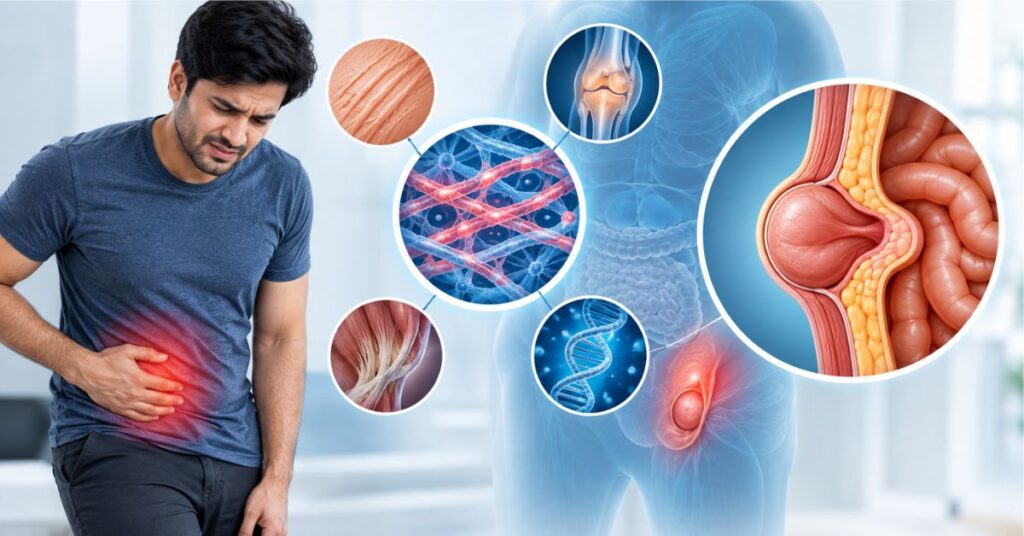
Most hernias are caused by mechanical strain – lifting, coughing or straining. But for some patients, the problem is not what they’re doing to their body, but how their body’s connective tissue is built in the first place.
What Are Connective Tissue Disorders?
Connective tissue disorders are a group of inherited diseases that affect collagen and other structural proteins that give the skin, joints, blood vessels, and abdominal wall strength and elasticity. Two of the better-known examples are the Ehlers-Danlos syndrome and the Marfan syndrome. In each, all body tissue is relatively more elastic and less resistant to normal pressure than normal connective tissue.
Why Connective Tissue Disorders Raise Hernia Risk
The strength of the abdominal wall relies heavily on collagen. If the connective tissue is weaker or more elastic, the abdominal wall is more likely to develop gaps or thin spots. People with these conditions tend to develop hernias at a younger age, sometimes without a clear inciting event such as heavy lifting, and may develop more than one hernia over time, including recurrence of a hernia after repair.
Implications for Diagnosis and Treatment
If you have a diagnosed connective tissue disorder or family history suggestive of one, it’s worth mentioning this explicitly in any hernia consultation. It can affect surgical approach, type of repair material used, and extent of follow-up care, as normal repair techniques do not always behave in the same manner in tissue that is structurally different from average.
- Please record any known connective tissue diagnosis before surgery and not only during the recovery period.
- Look for possible related signs like joint hypermobility or skin that stretches unusually easily
- Closer monitoring after surgery if you are in a higher-risk category
If you or your family have suffered from hernias numerous times without any apparent reason, consulting with a hernia specialist in Indore can help you find out if a connective tissue disorder is at play and what that could mean for your future treatment.