

Reviewed for medical accuracy. Only for informational purposes. Always get diagnosed and treated by a qualified hernia doctor in Indore.
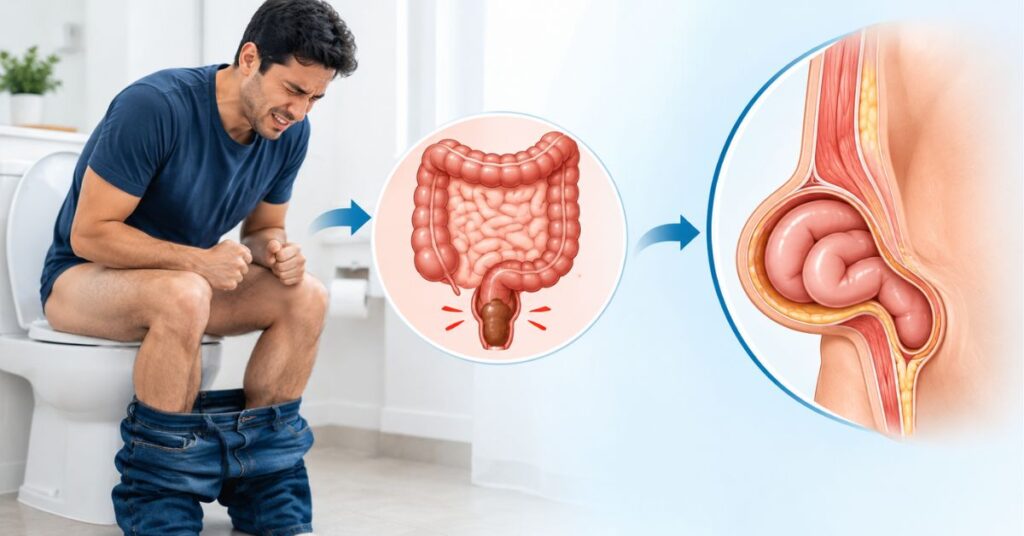
Most people associate hernias with something heavy or an old injury. That’s true in many cases but there’s another cause that gets far less attention: chronic constipation and the repeated straining that goes along with it. If you have a weakened abdominal wall (perhaps because you’ve had abdominal surgery in the past), straining during a bowel movement may be enough to cause a hernia—or make an existing one worse.
This connection happens often enough in clinical practice that it’s worth explaining in detail: what is really happening in the body, why straining is so damaging, and what can be done about it, both to prevent a hernia and to protect yourself during recovery if you’re already scheduled for hernia surgery.# What Is a Hernia, Briefly
A hernia is an internal organ or tissue that is protruding through a weak spot or tear in the muscle or tissue that normally contains it . Usually this is because part of the intestine pushes through a weak spot in the abdominal wall, creating a lump that can be seen, usually in the groin (inguinal hernia), near the belly button (umbilical hernia) or where a previous surgical cut was made (incisional hernia).
The abdominal wall tissue is not infinitely strong. It has natural weak points and can also be weakened by previous surgery, pregnancy, aging or genetic factors that influence strength of connective tissue. If a weak spot actually turns into a full-blown hernia, it’s often because of sustained or repeated pressure on that weak spot, and that’s where straining comes in.
Why Straining on the Toilet Increases Pressure
When you are straining to pass a hard or difficult stool, you are not just straining locally. Straining is the Valsalva maneuver, closing off the airway and contracting the abdominal muscles forcefully. This greatly increases pressure within the abdominal cavity, called intra-abdominal pressure.
The increased pressure is exerted in all directions, including against the abdominal wall itself. One hard strain can be enough to push tissue through a weakness in a person who already has one. Repeated straining over months or years will slowly stretch and weaken the tissue . Eventually a hernia occurs . This happens in a person with no weakness at first .
So, why is it that chronic constipation – it’s not just an occasional hard stool, but a pattern of straining several times a week, over a period of time – is a known risk factor for the development of hernia, and a common cause of hernia recurrence after surgery, if bowel habits are not corrected?
Who is Most Susceptible to This Combination
The link between straining and hernias is most relevant to a few specific groups:
- People with an undiagnosed, existing hernia, where straining can cause a small, previously asymptomatic hernia to suddenly become painful, enlarged or, in rare cases, develop complications requiring urgent care.
- Post-operative patients, especially in the weeks right after hernia repair, when the surgical site is still healing and much more susceptible to pressure than fully healed tissue.
- Older adults who lose some strength and elasticity of abdominal wall tissue naturally over time and also have higher rates of chronic constipation.
- Pregnant and postpartum women, whose abdominal wall tissue is already under a lot of strain from pregnancy itself.
- Anyone with a chronic condition that causes frequent straining**, such as long-term constipation caused by low fiber intake, dehydration, certain medications, or reduced mobility.
Warning Signs You Should Not Ignore
If you have chronic constipation along with any of the following, it’s a good idea to have it checked out by a hernia doctor instead of waiting:
- A new lump or swelling in the abdomen, groin or near a previous surgical scar, especially one that grows or looks more prominent when you strain or lift
- A dragging, aching or pulling feeling in the abdomen or groin, which worsens with bowel movements
- A soft, reducible (can be pushed back in easily) bulge becoming firm, painful or irreducible (can’t be pushed back in) – this can be a sign of a more serious complication and needs urgent medical attention
- Increased pain in the area of hernia repair during bowel movements
How to Control Your Bowel Habits to Prevent Hernias
Simple modifications will allow most people to manage chronic constipation, which greatly relieves the strain on the abdominal wall:
- Slowly increasing fiber in your diet through fruits, veggies, whole grains, and legumes to help make your poop softer and easier to pass
- Getting enough fluids not enough fluid and fiber can sometimes make constipation worse instead of better
- Incorporating regular physical activity into the day, which promotes normal bowel motility
- Don’t strain or hold your breath for long on the toilet; if you can’t have a bowel movement within a reasonable amount of time, it’s better to get up and try again later than to force it
- Discussing your medications with your doctor, because some common drugs have constipation as a known side effect
- Medical treatment for chronic constipation, if lifestyle changes are not enough, rather than continuing to strain over and over again in time
If you have had hernia surgery recently, it is especially important to manage your bowel habits during the healing period. Your surgeon may have specific recommendations about stool softeners or dietary modifications during early recovery to help decrease the strain on the repair.
Why This Matters Specifically for Patients Having Hernia Surgery
If you are preparing for or recovering from hernia surgery, chronic constipation is not a side issue; it directly impacts surgical outcomes. One of the more preventable contributors to hernia recurrence is straining during the early recovery period, which places direct pressure on the surgical repair before the tissue has had time to heal and integrate properly. Your hernia surgeon must have a good pre- and post-operative plan with specific instructions on bowel management, not just wound care.
When to Consult a Hernia Specialist:
Any bulge or discomfort or change in a known hernia, along with chronic constipation, are reasonable triggers to book a consultation rather than wait and see if it resolves itself. Hernias don’t resolve on their own, and putting off an evaluation, especially if a bulge becomes firm or painful, can turn a simple outpatient repair into something more urgent.
If you experience symptoms of a hernia or are concerned about your risk given a history of constipation, the best way to get a clear diagnosis and a treatment plan specific to your case is to see an experienced hernia doctor in Indore.